Mexico City has a subsidence problem. When the Aztecs were running things, most of the valley floor was covered by a series of shallow lakes (more on this below). Take away the water and that soft, spongy lakebed starts sinking under the weight of the buildings above. It's a problem with nearly all large, old buildings, but this church seemed to be faring the worst.
 The interior. The camera is pretty close to true; it's the church that's wonky. It was almost disorienting.
 But no less beautiful for being crooked.
 El Catedral.
 That's one hell of an entranceway.
 Looking down the main aisle.
 A more "creative" angle of the same.
 Think that's all real gold? Yes.
 Looking back towards the entrance. Damn, those are huge.. organs.
 It is a very large church.
 And some nice oils in the bishop's office.
 This is a model of the Templo Mayor that was once the centerpiece of the Aztec capital. For more than 450 years, it was thought to have been completely destroyed by Cortes and the cathedral constructed atop its foundations.
 Then, in 1978, electrical workers uncovered this guy. This photo was taken from the floor above, looking straight down. The disc is about 10' in diameter, a foot thick and weighs 8.5 tons. The colors are projected onto the stone to recreate its original paint job.
 So I guess maybe we should do some more digging? ¡Ay, puta madre! We, uh, we found the temple. It wasn't under the cathedral after all.
Note the successively larger stages of construction.
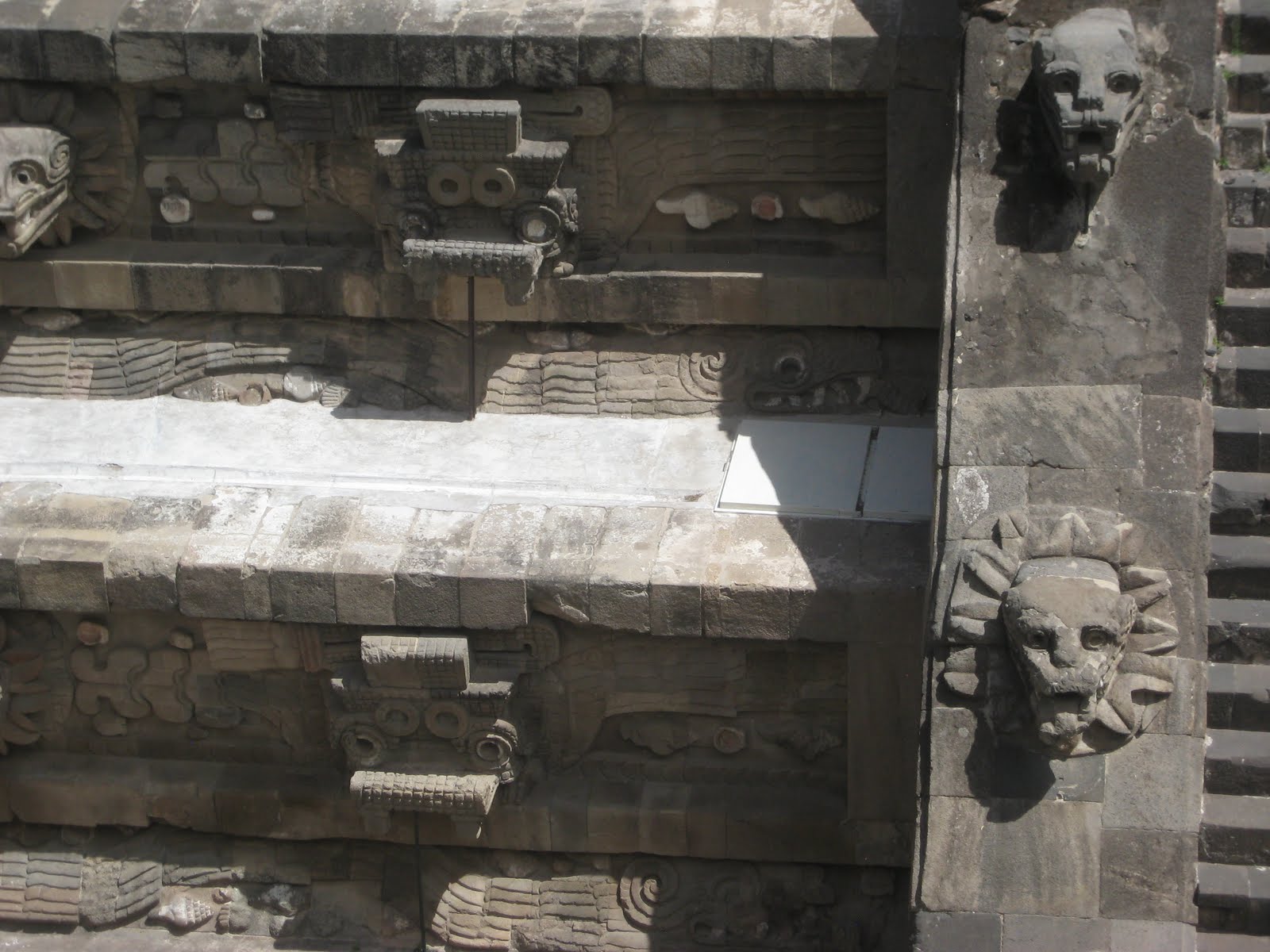 Original decorations, in situ.
 A different angle of the same.
 A not so subtle reminder of the many human sacrifices that were made here.
 More orignal exterior decorations. In the upper left is a "modern" building on the adjacent block; the Templo Mayor site and museum is completely surrounded by Mexico City and just off the main square, or Zócalo. In fact, the biggest barrier to serious architectural investigations of this site was the expensive colonial buildings sitting atop it.
 Eek! A snake!
 Eek! A human skull!
 Eek! WTF is that?
 Most of the artifacts recovered from the Templo Mayor were buried as part of sacrificial rites. There are shells, beads, semi-precious stones, pottery, carvings, etc. from all over Mexico and Central American, a testament to the wide extent of the Aztec empire. And, of course, human sacrifices were a regular part of their religious ceremonies.
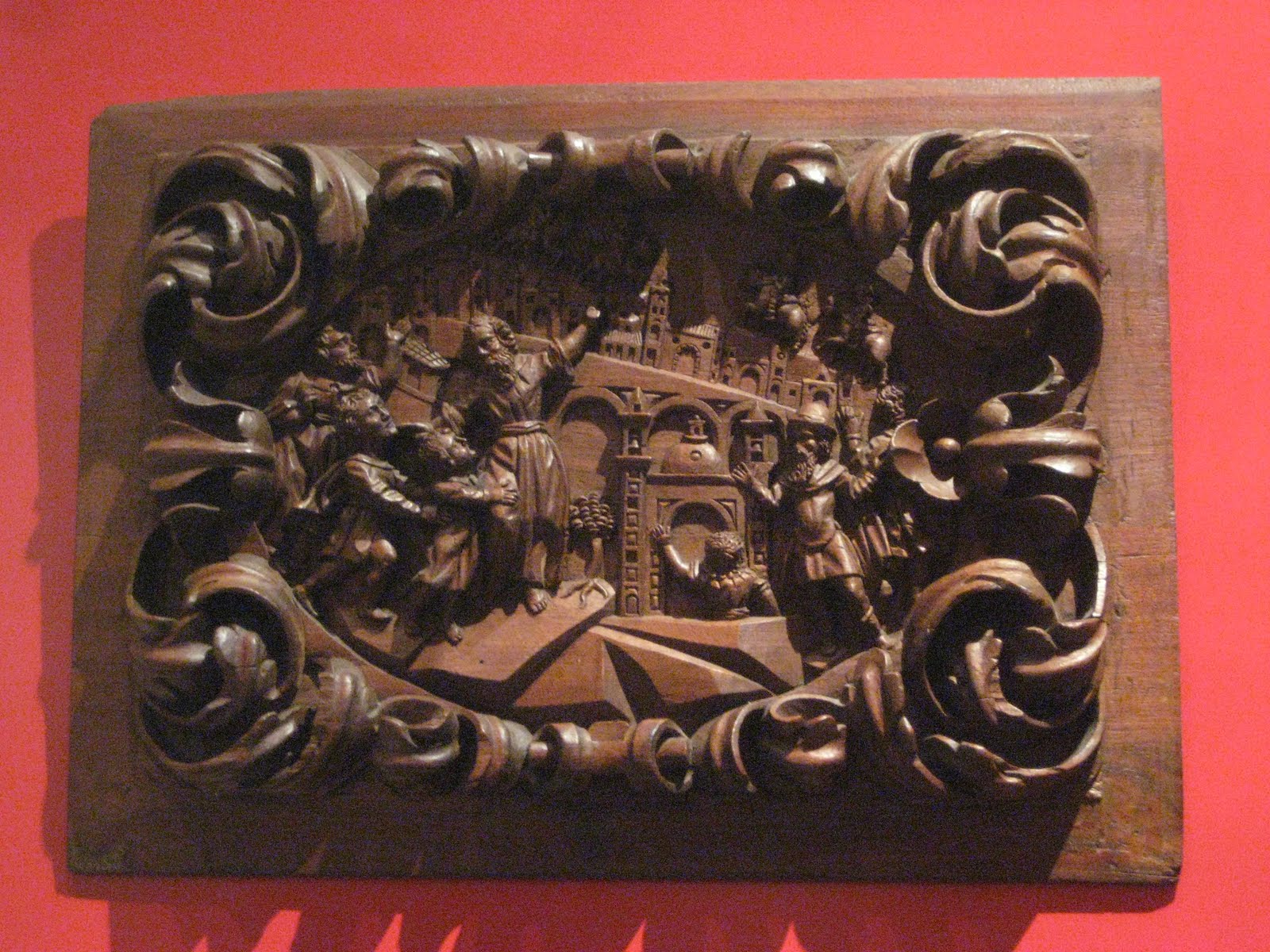 I went to a random museum because it was free that day and I am cheap. I rather like this carving.
 And I am madly in love with this door.
 This is the main post office. No, seriously, that dude in the white pants is probably just buying stamps or something.
 As I vaguely recall, the post office was constructed in the late 19th century and was meant to show off the power and wealth of Mexico.
 I think they largely succeeded.
 A thing that must be done in Mexico City is the Torre Latinoamerica, preferrably late in the day to appreciate the sunset. The elevator to the observation level costs 60 pesos, but there is a bar one floor down where the beers cost 40 pesos. Do the math.
 Yeah, well, fine, okay, to be perfectly honest, I bought two beers, so I spent more than I would have on just the elevator.
 But you know what I had that the other tourists didn't?
 Two beers.
 Mexico City's pollution, altitude and surrounding ring of mountains make for some pretty amazing sunsets, eh?
 My last day in Mexico City I took the subway to the end of the line and then the light rail to the end of the line to reach the floating gardens of Xochimilco.
 These canals are all that remain of the lakes that once covered much of the valley floor.
 Ducks!
 Would you like a snack to go with your boat ride? Perhaps some Mariachi music? No? Are you sure?
 I shared a boat with some Mexicanas because I'm che.. traveling solo and welcome the company. Yeah, that's it.
 On the bus to Puerto Escondido that night, an even more amazing sunset.